
“Are dental X-rays safe?” the answer is yes. X-rays play a key role in contemporary dental care. They aid dentists in finding problems not visible during a routine oral exam. Dentists use modern equipment and safety protocols when taking dental X-rays, keeping exposure minimal and the diagnostic advantages clear.
- Dental X-rays can reveal cavities between teeth.
- Dental X-rays helps to find the Infections around tooth roots, bone loss, impacted teeth, abnormalities.
- Dentists can utilize them to plan procedures like root canals, orthodontic treatments, dental implants, and other restorative measures.
What Are Dental X-Rays?
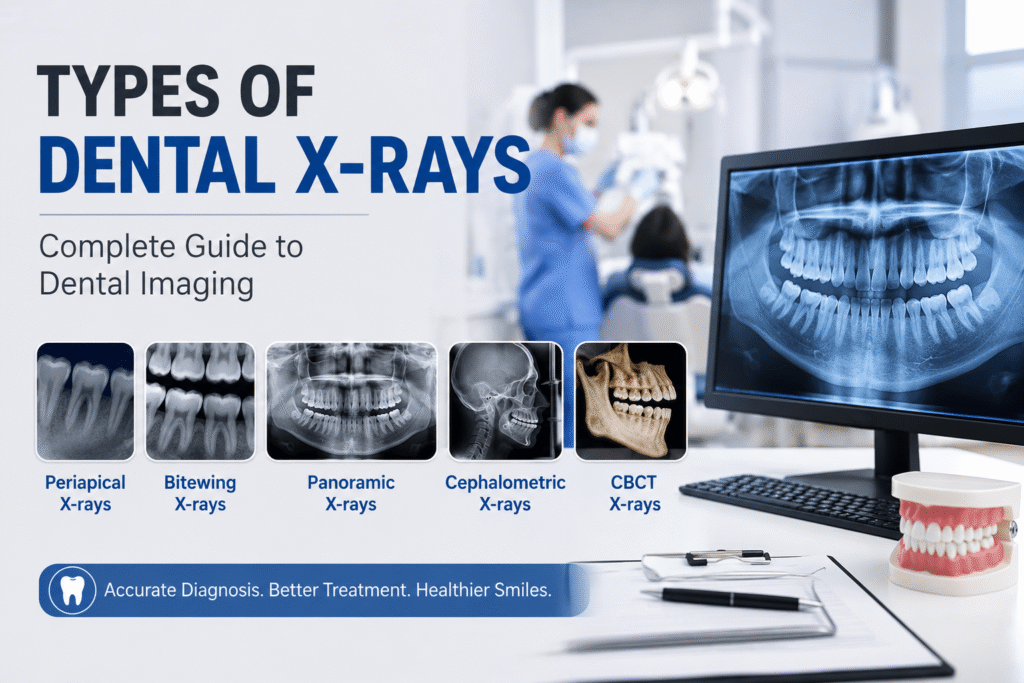
Dental X-rays, or dental radio graphs, are diagnostic images produced with a minimal amount of ionizing radiation, enabling dentists to view structures beneath the gums and within the teeth that are not visible through direct examination. Based on a patient’s symptoms and treatment requirements, dentists may utilize various types of X-rays, including bite wing, periodical, panoramic, or three-dimensional cone-beam computed tomography (CBCT) imaging.
There are different types of dental x-rays are there each x-ray has it’s own purpose
1. bite wing X-rays are frequently utilized to identify cavities located between teeth.
2. Panoramic X-rays offer a comprehensive view of the jaws and teeth, aiding in the assessment of wisdom teeth, orthodontic issues, and specific jaw conditions.
3. CBCT delivers three-dimensional imaging and is often utilized in specific scenarios, including precise planning for implants.
CBCT typically exposes patients to higher levels of radiation compared to standard dental X-rays, and current guidelines recommend its use only when the additional diagnostic information is deemed clinically necessary.
Why Do Dentists Recommend Dental X-Rays?
A dental examination is not capable of identifying all oral health issues, as some cavities may form between teeth, infections can arise around tooth roots, and changes in bone may occur beneath the gum line, often without evident symptoms during the initial stages.
Dental X-rays provide dentists with additional information to assist in confirming a diagnosis and identifying the most suitable treatment. Dental X-rays serve as a valuable tool in dental procedure planning, enabling dentists to assess tooth roots and surrounding tissues prior to treatments such as root canals.
Imaging in orthodontics serves to deliver essential insights regarding the alignment of teeth and the progression of jaw development. X-rays are diagnostic tools used to assess dental health and guide treatment decisions, rather than serving as routine photographs of the teeth.
Are Dental X-Rays Safe During Pregnancy?
Pregnant individuals may have concerns about the potential risks of dental X-rays to their developing baby. However, the American Dental Association states that dental radio-graphs can be safely conducted during pregnancy when deemed clinically necessary. These X-rays are concentrated on the mouth and head, avoiding direct exposure of the abdomen to the primary X-ray beam.
If you are pregnant or suspect you might be, inform your dentist prior to undergoing an X-ray. This allows the dental team to evaluate the need for imaging and apply suitable radiation-safety measures. Delaying essential dental procedures due to pregnancy could occasionally lead to complications from infections or other dental issues. According to the ADA, clinically indicated dental care, including radio-graphs, can safely be performed during pregnancy.
Dental x-rays may be overused but they are safe?
Dental X-rays are regarded as safe when deemed clinically necessary and conducted with advanced equipment and appropriate safety protocols. They utilize minimal radiation, with dentists adhering to the principle of minimizing exposure to the lowest reasonably achievable level.
Being safe does not justify unnecessary use; dental X-rays may be performed excessively if conducted routinely without evaluating factors such as the patient’s symptoms, oral health condition, prior X-rays, age, and specific treatment requirements.
Are dental x-rays are safe for kids?
Dental X-rays are considered safe for children when deemed clinically necessary and conducted with proper safety precautions. Since children exhibit greater sensitivity to radiation than adults, dentists carefully employ the lowest feasible radiation dose and select suitable X-ray types based on the child’s age and dental requirements. Additionally, modern digital X-ray technology contributes to reducing radiation exposure.
Dental X-rays should not be conducted on children as a routine procedure without a specific clinical indication. Dentists may suggest an X-ray to identify cavities between teeth, monitor the development of permanent teeth, detect infections, evaluate jaw growth, or assess orthodontic issues that are not visible during a standard examination. Parents are encouraged to inquire about the reasons for the recommendation and how the X-ray will contribute to their child’s dental care.